PTSolns Prototype PCB Microcontroller Shield Arduino Uno (NRF- | Shop The World
From USA
NewPTSolns
PTSolns Prototype PCB Microcontroller Shield for Arduino Uno (NRF-Shield Deluxe)
ℹ
Products from the USA may come with an input voltage of 110V–120V, requiring a step-down transformer. Check the device wattage to select the correct power converter.
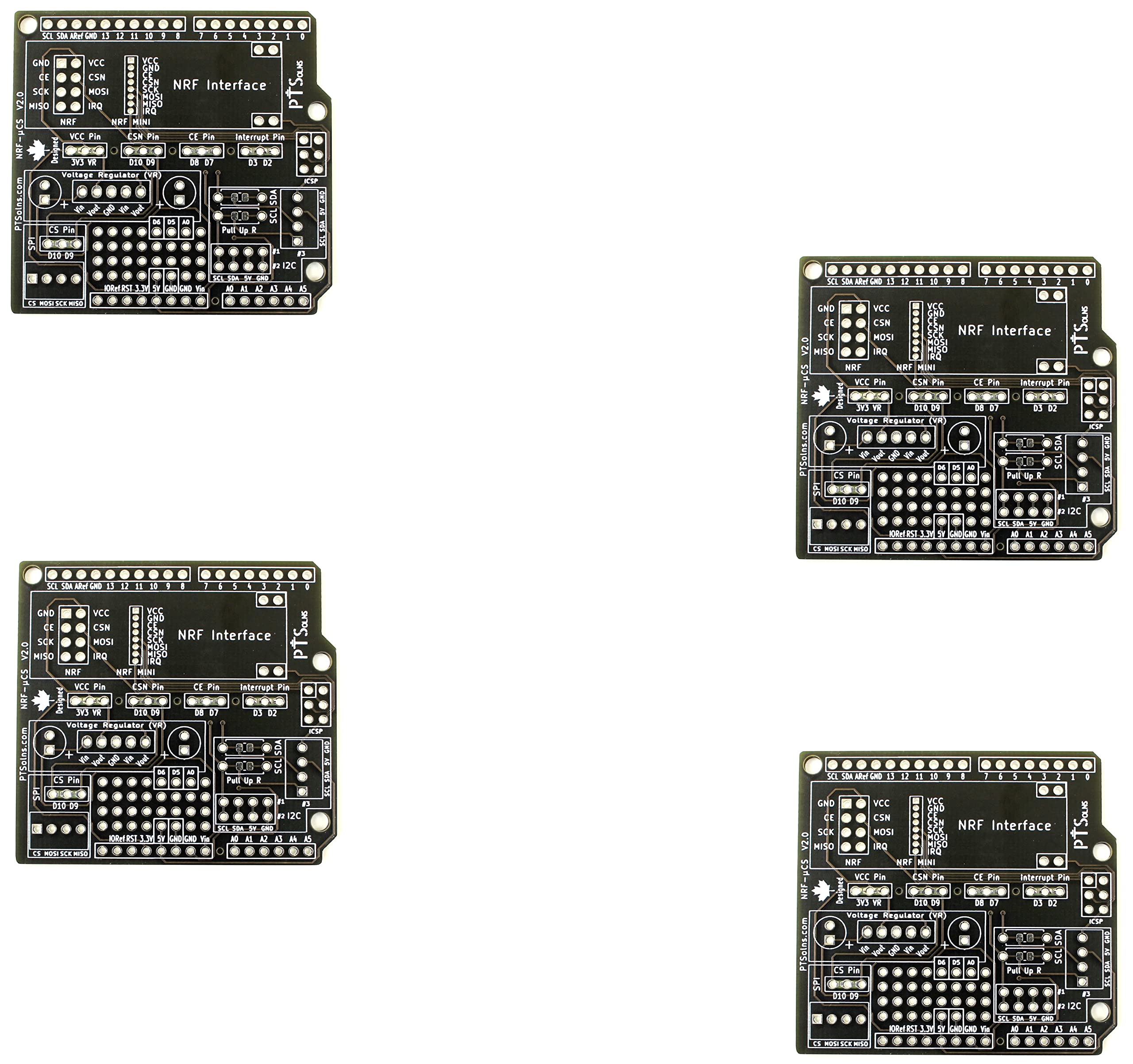
•What’s an Uno Shield?: An Uno shield is an add-on board that plugs (stacks) directly into an Uno, expanding its functionality with additional features like motor drivers, sensors, or communication interfaces. It aligns with the Uno's pin layout, making it easy to stack and integrate without extra wiring. With this NRF-Shield, you can add RF communication via the Nordic nRF24L01+ family of modules (mini, standard, +PA+LNA) to your project.
•Compatibility: The NRF-Shield is designed not just for the Uno microcontroller development board, but for any board that shares the same footprint. This includes the Uno R3, Uno R4, Leonardo, Mega, and many others. Although the NRF-Shield is stackable, it is recommended, for improved RF quality, to keep the NRF-Shield at the top of the stack.
•Packed with Features: The NRF-Shield is unlike any other. It is packed with features. The NRF interface allows to add any of the three common nRF24L01+ modules (mini, standard, +PA+LNA). Onboard is also an I2C interface, an SPI interface, and a prototyping section. For a full description of these features please see the Datasheet, which can be found on our “PTSolns Documentation Repository”.
•What’s Included: Each package includes two (2) PTSolns NRF-Shield plus the Deluxe Package. The *Deluxe* package comes with useful hardware to assemble the shield. See product image for details. SOLDERING IS REQUIRED.
•PTSolns Customer Support & Resources: We’re here to help. Contact PTSolns support for assistance or technical questions. Every PTSolns product is backed by our comprehensive resource library, including datasheets, schematics, 3D models, Fritzing files, and tutorials. All supporting material is freely available on our “PTSolns Documentation Repository”.